Lessons / Lesson 1, Gibson & Shelley, Ch. 3 (protocols)
DNSSEC: a wax seal on the internet’s address book
DNSSEC puts a seal on the internet’s address book, so you know the address you were given is real and nobody swapped it on the way.
Like you’re 10
The internet has a giant address book called DNS. When you type eli10cyber.com, your computer asks the address book, “Where does this website live?” and gets back a house number (an IP address).
But what if a sneaky person swapped the page in the address book? You’d go to their house instead, and it might look exactly like the real one.
DNSSEC adds a wax seal to every answer. Only the real owner can make that seal, but anyone can check it. If the seal is broken or missing, your computer says “Nope, that’s not trustworthy” and refuses the fake address.
And who vouches that the seal itself is real? The parent book does. The .com book says “this is the real seal for eli10cyber.com”, and the root book at the very top says “this is the real seal for .com”. Everyone checks the chain all the way up.
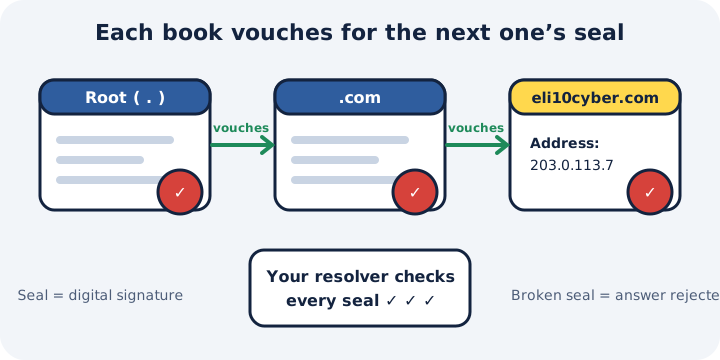
The chain of trust: each level vouches for the seal below it. Tap to enlarge.
Grown-up version
DNS Security Extensions (DNSSEC) add cryptographic signatures to DNS data so that a validating resolver can confirm two things: the answer came from the authoritative source (authenticity), and it wasn’t altered in transit (integrity).
The key record types:
| Record | What it does | In the kid version |
|---|---|---|
| RRSIG | The digital signature over a set of DNS records | The wax seal |
| DNSKEY | The zone’s public keys, used to check signatures | The stamp pattern everyone can compare against |
| DS | A hash of the child zone’s key, stored in the parent zone | The parent vouching for the child’s seal |
| NSEC / NSEC3 | Signed proof that a name doesn’t exist | A sealed note saying “no such page” |
This creates a chain of trust from the root zone (signed since 2010), through the top-level domain (.com), down to your domain. If any link fails to validate, the resolver treats the answer as bogus and the lookup fails.
What DNSSEC does not do (a classic exam trap):
- It does not encrypt DNS. Lookups are still visible. For privacy, you need DNS over HTTPS (DoH) or DNS over TLS (DoT).
- It does not stop DDoS attacks on DNS servers.
- It does not protect you if the attacker controls your registrar account. They could simply change the real records. That’s why registrar accounts need strong MFA.
Why it exists: in 2008, researcher Dan Kaminsky showed how easily attackers could poison resolver caches at scale. DNSSEC is the long-term fix for that class of attack.
What I did on my own site
When I registered eli10cyber.com on Cloudflare, turning DNSSEC on took one click in the domain’s settings. Cloudflare then sent the DS record up to the .com registry for me. Anyone can check it: look the domain up on lookup.icann.org and the DNSSEC field shows signedDelegation.
So this very website is protected by the thing this lesson is about.
Why a buyer cares
- The risk it reduces: customers being silently redirected to a fake site, which leads to credential theft, payment fraud and brand damage. For banks, retailers and government services, that’s a board-level worry.
- Who owns it at a company: usually the network or infrastructure team (often called the DNS or “DDI” team), with input from security. Domain registration itself sometimes sits with legal or marketing, which is how important domains get forgotten.
- What gets bought: DNSSEC itself is rarely sold on its own. It’s a feature inside bigger purchases: managed DNS (Cloudflare, Akamai, AWS Route 53, Azure DNS), DDI platforms that combine DNS, DHCP and IP management (Infoblox, BlueCat, EfficientIP), and enterprise registrars with domain-locking and brand protection.
- Compliance angle: US federal agencies have been required to sign their
.govdomains with DNSSEC since 2008, and it appears in many security baselines.
A good discovery question if you sell in this space: “If someone hijacked DNS for your main customer login domain this afternoon, how quickly would you know, and who would get the call?”
The one thing to remember
DNSSEC answers “Is this address real?”, not “Can anyone see what I looked up?” Integrity, not confidentiality.
Test yourself
Answer out loud first, then check.
1What does DNSSEC add to DNS?
Digital signatures. They let a resolver check that a DNS answer is authentic and hasn’t been changed.
2Does DNSSEC encrypt your DNS lookups?
No. It protects integrity and authenticity, not confidentiality. Anyone on the path can still see what you looked up. Encrypted DNS (DNS over HTTPS or TLS) handles privacy.
3Which record in the parent zone links it to the child zone’s key?
The DS (Delegation Signer) record. It holds a hash of the child’s key, which builds the chain of trust from the root down.
4Which attack is DNSSEC mainly designed to stop?
DNS spoofing and cache poisoning, where an attacker slips a forged answer into a resolver so people are sent to the wrong server.
5Which record holds the actual signature on a set of DNS records?
RRSIG. The public key used to check it is published in a DNSKEY record.
Your progress is saved on this device only.